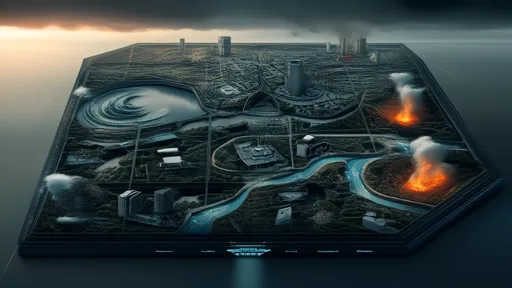
The concept of a regional climate sandbox is revolutionizing how we approach disaster modeling and resilience planning. By breaking down vast geographical areas into one-square-kilometer grids, scientists and policymakers can now simulate climate-related disasters with unprecedented precision. This granular approach allows for hyper-localized risk assessments, transforming abstract climate projections into actionable insights for communities worldwide.
At the heart of this methodology lies the integration of high-resolution climate data with advanced computational models. Unlike traditional regional-scale modeling that often glosses over microclimates and topographical nuances, the kilometer-grid system captures how a typhoon's rainfall might flood specific city blocks or how wildfire embers could jump between particular forest stands. Urban planners in Tokyo are already using such simulations to test how their flood barriers would perform under various typhoon scenarios, while Californian fire departments are mapping ember propagation patterns down to individual neighborhoods.
The sandbox approach particularly shines when modeling compound disasters – those cascading events where one catastrophe triggers another. A simulated heatwave in the grid system might first show pavement temperatures reaching levels that buckle roads, then model how these transportation failures would hinder evacuation during subsequent flash flooding. Researchers at the Singapore Climate Center recently demonstrated how their grid model predicted localized urban heat island effects that traditional models missed, revealing pockets of vulnerability where elderly populations faced dangerous temperature spikes.
What makes these sandbox environments truly groundbreaking is their iterative testing capability. Planners can simulate hundreds of disaster variations within hours – tweaking variables like wind direction, soil saturation, or building materials – to identify which interventions provide the most robust protection. After the 2023 Türkiye earthquakes, reconstruction teams employed grid modeling to test how different building codes would perform across various geological conditions, creating customized resilience strategies for each kilometer grid.
The computational demands of such detailed modeling are staggering. A single regional simulation might require processing petabytes of real-time data from IoT sensors, satellite feeds, and drone surveys. Cloud computing platforms have become essential collaborators, with Microsoft's Azure recently deploying specialized climate modeling units that can process grid-based disaster scenarios 40% faster than conventional supercomputers. This processing power enables near-real-time updates during unfolding disasters, allowing emergency responders to adjust strategies as conditions change.
Critically, these grid models are bridging the gap between scientific projections and community preparedness. When residents in Miami's Little Haiti neighborhood saw simulations showing exactly which streets would flood first during different hurricane categories, they prioritized elevating certain roads and creating community-designed drainage solutions. The visual nature of grid-based projections – often displayed as color-coded maps – makes climate risks tangible for non-experts, fostering more informed public debates about adaptation investments.
Emerging applications extend beyond immediate disaster response. Insurance companies are experimenting with kilometer-grid models to develop dynamic pricing systems that adjust premiums based on hyperlocal risk assessments. Reinsurers like Swiss Re have created "digital twin" simulations of entire cities, allowing them to stress-test portfolios against thousands of possible climate scenarios. Meanwhile, agricultural cooperatives from Kenya to Kansas are using similar technology to micro-target crop insurance products and drought mitigation strategies.
The technology isn't without its controversies. Some privacy advocates warn that the data requirements for such precise modeling could lead to surveillance overreach, particularly when combining climate data with detailed infrastructure maps and mobile location patterns. There are also concerns about "model determinism" – the risk that communities might over-rely on simulated projections when real-world disasters inevitably contain unpredictable elements. The 2024 Jakarta flood simulations, for instance, accurately predicted inundation areas but underestimated how clogged waterways would alter water flow patterns.
Looking ahead, the next evolution of climate sandboxes involves integrating AI agents that can autonomously run millions of disaster permutations, identifying rare but catastrophic scenarios that human modelers might overlook. The European Climate Foundation recently demonstrated an AI system that discovered an unlikely but plausible chain of events where a Mediterranean heatwave could trigger simultaneous power failures in Barcelona's subway system and hospital network. Such findings are prompting cities to rethink the interconnectedness of their critical infrastructure.
From small island nations preparing for king tides to megacities bracing for superstorms, the kilometer-grid approach is democratizing access to sophisticated climate modeling. When Tonga recently established its national climate strategy, officials worked with researchers to create customized grid models that accounted for the unique way tropical cyclones interact with the archipelago's volcanic topography. This level of localized insight – impossible with broader-scale models – is helping vulnerable communities worldwide prepare for an uncertain climatic future with eyes wide open.
The true test of these climate sandboxes will come when predicted disasters strike. Early indications suggest the models are proving their worth – during last year's Pacific typhoon season, grid-based flood predictions in Taiwan were accurate within 10 centimeters for 78% of monitored locations. As computing power grows and datasets expand, what began as an academic exercise is rapidly becoming an indispensable tool in humanity's race to adapt to rapid environmental change.

By /Jul 28, 2025
By /Jul 28, 2025

By /Jul 28, 2025

By /Jul 28, 2025

By /Jul 28, 2025

By /Jul 28, 2025
By /Jul 28, 2025
By /Jul 28, 2025
By /Jul 28, 2025

By /Jul 28, 2025

By /Jul 28, 2025

By /Jul 28, 2025

By /Jul 28, 2025
By /Jul 28, 2025

By /Jul 28, 2025

By /Jul 28, 2025
By /Jul 28, 2025
By /Jul 28, 2025

By /Jul 28, 2025

By /Jul 28, 2025
