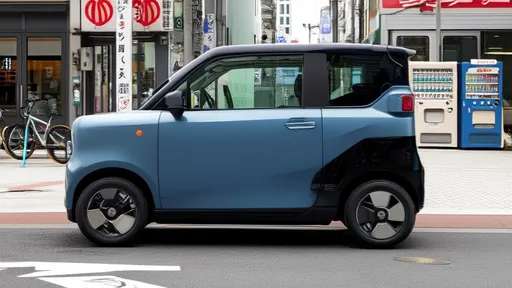
Honda Motor Co. has officially launched its new lightweight electric vehicle in Japan, priced at an accessible ¥2.68 million, or approximately $18,300. The model, named the Honda e-Mini, is designed specifically to tap into the nation’s thriving market for compact urban cars, known locally as kei vehicles. This strategic move signals Honda’s deepening commitment to electrifying its lineup while catering to the unique demands of Japanese drivers.
The new Honda e-Mini enters a segment historically dominated by gasoline-powered models from Suzuki, Daihatsu, and Honda itself. With dimensions and specifications that conform to Japan’s strict kei car regulations—including a length under 3.4 meters, a width under 1.48 meters, and an engine capacity limit of 660cc for ICE versions—the e-Mini is positioned as a fully electric alternative to popular models like the Honda N-Box and Suzuki Wagon R.
Industry analysts see the introduction as a critical test of consumer appetite for electric kei cars, which have been slower to adopt electrification compared to standard passenger vehicles. Honda is betting that its brand reputation, combined with the lower operating costs and environmental benefits of an EV, will convince practical-minded urbanites and suburban families to make the switch.
Powering the e-Mini is a compact lithium-ion battery pack that delivers a range estimated at 200 kilometers (124 miles) on a single charge under Japan’s WLTC standards. While this range is modest by global EV standards, it is considered more than sufficient for the daily commuting and errand-running patterns typical of kei car owners in Japan’s densely populated cities and towns.
Charging convenience is a key selling point. The vehicle supports standard home charging, reaching a full charge overnight, and is also compatible with the growing network of public quick-charging stations across Japan, allowing for a significant battery top-up in under thirty minutes. Honda has partnered with several charging infrastructure providers to offer preferential access or bundled services for early e-Mini adopters.
In terms of design, the e-Mini retains the iconic, boxy, and space-efficient silhouette characteristic of the kei segment but incorporates Honda’s modern electric vehicle design language. A clean, minimalist front end replaces the traditional grille, and sleek LED lighting gives the car a contemporary look. The interior, despite the small exterior footprint, is engineered to maximize cabin space, offering surprising headroom and legroom, along with versatile seating configurations and ample cargo capacity for its class.
Technology features are notably advanced for the segment. The e-Mini comes equipped with a digital instrument cluster and a central touchscreen infotainment system that supports smartphone connectivity, navigation optimized for EV range, and Honda’s proprietary connected services. A suite of Honda Sensing safety and driver-assist technologies, including collision mitigation braking, adaptive cruise control, and lane-keeping assist, is available even on the base trim, a rarity in the cost-sensitive kei category.
The pricing strategy is particularly aggressive. At ¥2.68 million, the e-Mini undercuts many expectations and positions itself as a premium but attainable option. When combined with Japanese government subsidies for electric vehicle purchases, which can reduce the effective price by several thousand dollars, the e-Mini becomes a compelling financial proposition, potentially matching or even undercutting the total cost of ownership for equivalent gasoline-powered kei cars over time.
Honda’s decision to focus its initial EV push in Japan on the kei segment is a shrewd recognition of market realities. These small cars account for nearly 40% of all new vehicle sales in Japan, representing a massive and stable customer base. Success here could provide Honda with a powerful domestic launchpad for its broader global electrification strategy, generating crucial volume, brand momentum, and real-world data on EV usage.
However, the company faces significant challenges. The market is intensely competitive, and rivals are not standing still. Suzuki and Daihatsu have also announced plans for electric kei models, and Nissan’s Sakura electric minicar, launched earlier, has already garnered strong sales and critical acclaim. Honda must convince buyers that the e-Mini offers a superior package of value, technology, and driving experience.
Furthermore, the infrastructure challenge, while improving, remains. Widespread adoption of EVs in Japan, even in the urban-focused kei segment, depends on the continued rapid expansion of reliable and convenient charging options, particularly for the large portion of customers who live in apartments without dedicated parking.
The launch of the Honda e-Mini is more than just another new model; it is a bellwether for the electrification of Japan’s automotive heartland. Its performance in the showroom will be closely watched by executives, competitors, and policymakers alike. A strong reception could accelerate the entire industry’s transition to electric powertrains in a segment where efficiency and practicality are already paramount. If successful, the humble Honda e-Mini could become the vehicle that truly brings electric mobility to the masses in Japan.

By /Sep 15, 2025

By /Sep 15, 2025

By /Sep 15, 2025

By /Sep 15, 2025
By /Sep 15, 2025
By /Sep 15, 2025

By /Sep 15, 2025

By /Sep 15, 2025

By /Sep 15, 2025

By /Sep 15, 2025

By /Sep 15, 2025

By /Sep 15, 2025
By /Sep 15, 2025

By /Sep 15, 2025

By /Oct 10, 2025

By /Sep 15, 2025

By /Sep 15, 2025

By /Sep 15, 2025

By /Sep 15, 2025

By /Sep 15, 2025
